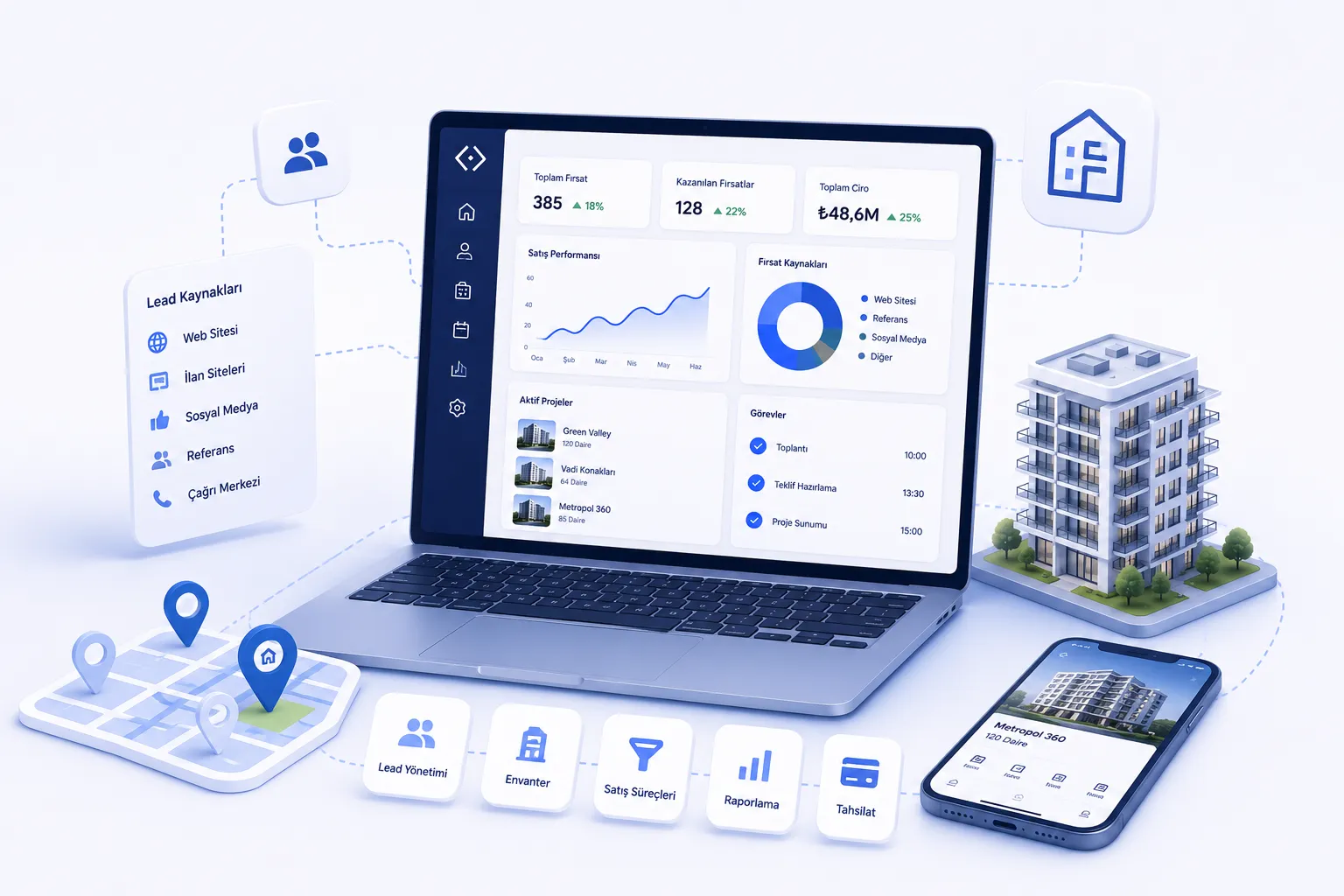

On teams that switch to AI-supported lead scoring, prediction accuracy rises from 71% to 89%. According to data compiled by MindStudio, a real estate firm loses an average of $427 for every lead it misses; the industry average response time reaches 15 hours. AI in real estate sales closes exactly this gap: it tells you which customer is hot within seconds.
In this guide you'll find:
- How AI differs from sales automation and why it accelerated in 2026
- The AI sales pipeline that runs from lead scoring to conversion prediction
- Concrete examples from Turkey and the KVKK and explainability dimension
What is AI in real estate sales?
AI in real estate sales is technology that analyzes sales data and produces forecasts. It handles work like lead scoring, conversion prediction, portfolio matching and valuation within seconds. Its core difference is that it learns: when a sale closes it updates its model and sharpens the next prediction.
This is a step beyond classic automation. Automation runs rules; AI finds patterns and calculates probabilities. The two produce the strongest result when they work together. To see the automated side of these processes in more depth, take a look at our real estate sales automation guide.
According to the technical summary shared by Reform, these systems use machine learning models such as logistic regression, random forest and XGBoost. These models calculate a lead's likelihood of converting by looking at historical data.
Why now?
AI is no longer an experimental curiosity but a spreading standard. According to a thisandthat.chat compilation, enterprise AI adoption rose from 68% in 2024 to 78% in 2025. According to data reported by TheAIConsultancy, AI-focused venture capital investment in PropTech exceeded $630 million in 2023.
The transformation is accelerating in Turkey too. According to industry data reported by EmlakDream, the number of real estate valuation reports prepared in the first half of 2026 surpassed the 500,000 mark. Emlakjet, using Endeksa's AI technology, launched an assistant called EmlakZeka, adding estimated value, rental yield and an investment score to its listing pages.
This picture points to one clear outcome: the office that works with data pulls ahead. Competition is no longer decided by who enters the most listings, but by who manages data more intelligently.
AI lead scoring: find the hot lead in seconds
Not every lead is the same. Some are just browsing, while others are ready to move. AI lead scoring assigns each prospect a score based on behavioral signals and surfaces the most likely buyer.
The typical signals the system tracks are:
- Viewing or favoriting the same listing again and again
- Saved searches and a consistent price range
- Email open, click and response speed
- Signs of financial readiness such as mortgage pre-approval
When these signals combine, the difference is large. According to data reported by MindStudio, accuracy in AI-supported scoring rises from 71% to 89%. Reform notes that these models deliver a 20-30% improvement in conversion rate and automate 90% of routine qualification work.
The result is a reallocation of the advisor's time. The system routes the hot lead to the right advisor; the advisor then works from a priority list rather than an alphabetical one. Our AI and reporting modules bring this scoring logic together in a single panel.
Predictive analytics and conversion prediction
Scoring measures the present; predictive analytics forecasts the future. The goal is to know in advance how likely a lead is to buy or sell. Luxury Presence compares it to a weather forecast: the system distills dozens of signals that couldn't be tracked one by one into a single probability score.
This approach changes the definition of a prospect. According to an example reported by Marquiz, platforms like Offrs analyze more than 250 data points per property to produce a "seller score" and flag homeowners with a high likelihood of selling within 12 months. That way the advisor focuses not on the whole region, but on the segment giving the strongest signal.
The impact is measurable. According to Luxury Presence data, advisors who pair predictive scoring with a CRM earn 40% higher gross commission income. In a case study shared by the same source, AI-supported follow-up turned $1,400 in ad spend into a $6 million sale.
In short, predictive analytics turns "volume-focused" prospecting into "accuracy-focused" prospecting. Instead of casting a wide net, the advisor devotes their time to the most likely customer.
From lead to close: the AI sales pipeline
AI's real power emerges not in a single feature, but in an end-to-end pipeline. The six steps below show the AI-supported path a lead follows from capture to close.
- Capture: The system instantly records leads arriving from forms, portals and social media.
- Scoring: The system gives the lead a score based on behavioral signals.
- Segmentation: The system automatically sorts leads into hot, warm and cold.
- Instant response: The system routes the hot lead to an advisor and moves the warm lead into an automated nurture sequence.
- Personalized follow-up: The system adapts the message to the listing the prospect viewed.
- Conversion prediction: The model surfaces the prospects closest to a close.
Speed on this pipeline is critical. In an application reported by Luxury Presence, AI-supported automated responses raised the lead reply rate above 50%. Giving the first response within minutes means catching the prospect while they're still thinking. To build this flow, ready-made integrations connect WhatsApp, Meta Lead Ads and call channels to a single point.
Valuation and price prediction
AI scores not only the customer but also the property. Automated valuation models (AVMs) combine comparable data, regional developments and economic indicators to produce a price range. This creates a common reference point for both buyer and seller.
This field is maturing in Turkey. Endeksa offers automated valuation for residential and commercial real estate within seconds; Kolayimar performs zoning and parcel queries with AI. According to an industry view reported by EmlakDream, AI and data analytics are becoming an inseparable part of valuation processes.
Combining valuation with visual presentation speeds up sales. Showing the customer the property via a digital 3D model alongside the price makes the decision concrete and builds trust.
What AI won't do: reality vs. hype
AI is powerful, but not magic. Setting expectations correctly is essential to avoid budgeting for misleading claims. The most common exaggeration is the claim that "AI manages the customer alone until they buy." That does not reflect reality.
The industry's shared view is clear: AI does not replace the advisor, it strengthens them. Just as the calculator did not eliminate accountants, AI will not eliminate advisors. The trust, empathy and negotiation instinct a family needs when buying a home cannot be imitated by a model.
The correct framing is this: AI takes on the grunt-work analysis, and the advisor manages the relationship and the close. As Marquiz emphasizes, a healthy system must be "explainable"; the advisor should be able to see which signals a score is based on. An opaque black box carries the risk of unfair targeting and missed opportunity.
KVKK and explainable AI
Because AI works with personal data, its legal dimension cannot be ignored. In Turkey, this means direct KVKK and İYS obligations. Skipping this step creates the risk of an administrative fine.
The core headings of compliance are:
- Explicit consent and privacy notice: Processing data for marketing purposes requires prior, informed explicit consent.
- İYS registration: Sending commercial messages by automated SMS, email or call requires registration with the Message Management System (İYS).
- Explainability and audit trail: Scoring logic must be traceable; modern systems make compliance documentable with audit logs.
- Bias control: Criteria should be reviewed regularly so the model does not unfairly screen out certain groups.
A transparent approach protects both customer trust and regulatory compliance. For a compliant infrastructure, İYS and channel integrations together with a transparent KVKK policy are the starting point.
How to get started
Moving to AI doesn't have to be a giant project. The four steps below provide a realistic start for most real estate offices.
- Start with a single feature. Turn on only lead scoring at first; keep the other modules off.
- Compare the system with your own intuition. Did the lead the model called "high" really turn out to be a buyer? Note the differences.
- Add matching and prediction gradually. A week of observation generates enough data to interpret.
- Measure and expand. As metrics like conversion rate and response time improve, add new modules.
Systems that work with independent modules make this transition easier. You can start with an AI-powered CRM that fits your needs and broaden the scope as operations grow. Industry-specific solutions for different team structures also adapt this path.
Conclusion
AI in real estate sales is not a luxury reserved for large firms; it is an accessible advantage for offices of every size. The four standout points are:
- AI lead scoring surfaces the hot customer within seconds and pushes accuracy to 89%.
- Predictive analytics turns prospecting from volume to accuracy, raising commission income.
- AI does not replace the advisor; it takes the grunt work and leaves the relationship to the advisor.
- KVKK, explicit consent and explainability are an inseparable part of the setup.
To see your team's entire process from lead scoring to conversion prediction on a single platform, request a demo from Evon. For more content, explore the Evon Blog page.
Free Evon demo
See for yourself how Evon can add value to your sales process.
Frequently Asked Questions
What does AI do in real estate sales?
In tasks like lead scoring, predictive analytics and valuation, it surfaces the most likely buyer. It tells the advisor who to call first.
How accurate is AI lead scoring?
It depends on model quality. According to industry data, accuracy in AI-supported scoring can rise from 71% to 89%.
What is conversion prediction?
It is forecasting a lead's likelihood to buy or sell with a data-driven score. Like a weather forecast, it produces probabilities, not certainties.
Will AI replace real estate advisors?
No. AI takes on routine analysis; human stages such as trust, empathy and negotiation stay with the advisor.
Is using AI compliant with KVKK?
Yes, when set up properly. Explicit consent, a privacy notice and explainable scoring are essential; automated messages require İYS registration.