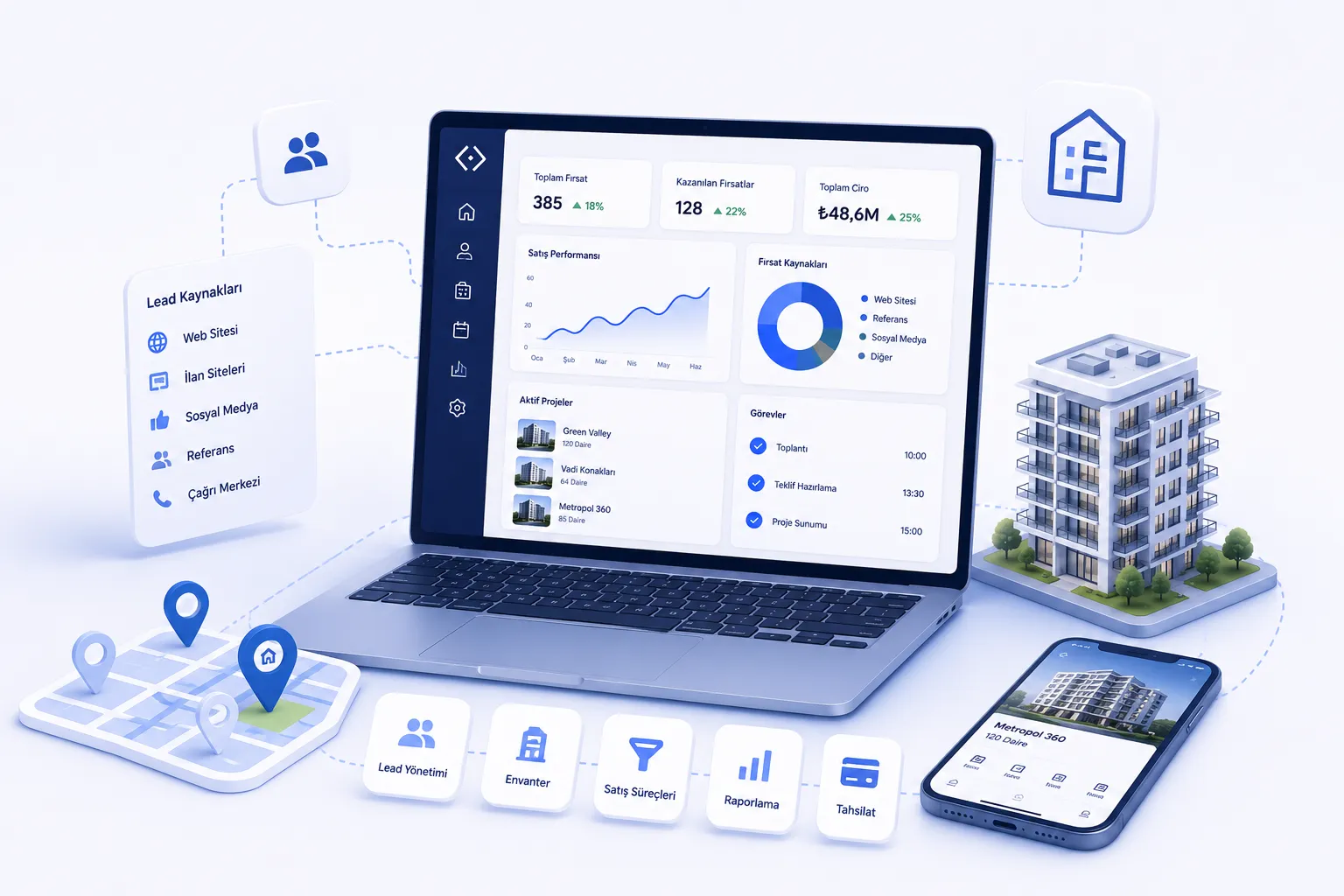
A CRM's feature list doesn't change by sector; how that list is used does. In construction firms sales does not run independently of production: what is sold is an unfinished unit, the handover date depends on construction progress, and the collection calendar is usually read alongside the progress-payment calendar.
This article is not about selection criteria but about where a construction firm uses the same software differently from other sectors. If you haven't yet decided which CRM to choose, our real estate CRM selection guide covers the full set of criteria.
When the site and the sales office see different tables
The most common picture is this: the sales office keeps its own spreadsheet, the site keeps its own progress file, accounting keeps its own collection list. All three believe they are working with correct data, but all three were last updated on a different day.
The consequences are concrete:
- An advisor tells a customer "handover in the last quarter"; on site the work programme has slipped by two months.
- A unit has been placed on option but the information never reached the other advisor, so the same unit is presented twice.
- A customer calls with a payment question; the advisor has to call accounting and the answer arrives the next day.
When a single source of data is established, the gain is not a report but a conversation: while talking to the customer the advisor can see the unit's status, payment position and estimated handover on one screen.
The CRM's core unit changes
In other sectors a CRM revolves around the person and the opportunity. In construction it revolves around a physical asset: project → block → floor → unit. The sale happens at the lowest unit of that hierarchy, and that unit is singular — the same apartment cannot be sold twice.
In practice this makes three things mandatory:
- Unit-level status: available, on option, reserved, sold. A status change must reach every user immediately.
- Option windows: when the window expires the unit must reopen for sale automatically; otherwise inventory looks sold out on paper only.
- Premium pricing: because floor, aspect and view differences feed into price, the price list cannot be derived from a single per-square-metre rate. We covered that calculation in how premium pricing is determined.
Construction progress becomes a sales argument
In a project under construction the buyer is purchasing something they cannot see. Progress information is therefore a sales tool — but only while it is current.
When shell-stage, fit-out and landscaping progress coming from the site lands in the CRM, two things become possible. First, the advisor can give a date in the meeting instead of guessing. Second, customers at contract stage can be sent regular progress updates, which noticeably reduces the volume of complaints before handover.
The practical setup works like this: a completion rate is held for each main item in the work programme, and when the rate is updated every sales record on that project sees the same figure. Photographs and documents attach to the same record, so "which stage were we at last month" does not turn into an archive search.
Reading progress payments with the collection calendar
A construction firm's cash flow runs in two directions: instalments coming in from customers on one side, progress payments going out to subcontractors on the other. When these live in separate systems, how much comes in and how much goes out in a given month can only be seen by combining them by hand.
When the collection calendar held on the CRM side and the progress-payment calendar tied to construction progress are read under the same project, these questions become answerable:
- Does the amount due to be collected this month cover the progress payment due in the same month?
- Which construction item do overdue collections put at risk?
- Is the sales pace producing the cash inflow the work programme requires?
Calculating the progress payment itself is an accounting job and stays there; what is needed on the CRM side is for the progress rate and the collection position to appear side by side on the same project screen.
Where subcontractor coordination touches sales
Subcontractor management is not a sales process, but it touches sales at two points.
The first is the handover date. A subcontractor slipping behind programme invalidates the commitment the sales team gave the customer. That slippage needs to reach the sales side as data, not as hearsay.
The second is the post-handover defect and warranty process. If it is not recorded which subcontractor's scope a reported deficiency falls under, resolution takes longer and the matter is charged to the firm's reputation. Tracking the report on the customer record and the work on the relevant construction item shortens that loop.
Project-level reporting: one dashboard isn't enough
In a single-project firm total figures do the job. Once two or more projects run in parallel the total misleads: one project doing well hides another one stalling.
The breakdown a construction firm needs is this:
- Sales pace per project: units sold per month and how many months the remaining inventory lasts at that pace.
- Lead cost per project: the same budget does not produce the same result on two projects; channel performance must be measured per project.
- Demand distribution by block and floor: a type moving slower than expected is an early signal for price and premium adjustment.
- Collection performance per project: the overdue ratio can differ markedly between projects.
Permissions follow the same breakdown. One project's sales team seeing another project's pricing and customer data is usually undesirable, which is why role- and project-level permissions are used more often in construction than in other sectors.
Different screens on site and in the sales office
Two different environments use the same CRM and their needs do not overlap.
In the sales office the screen is large, the customer is opposite you, and what needs showing is the project: unit selection, floor plans, payment plans. On site the screen is a phone, the connection is weak, and what needs entering is progress: construction rate, photographs, deficiency lists.
When this distinction is ignored, the typical outcome is that the CRM is not used in the field at all and the data is typed in at the office in the evening — that is, late and incomplete. The minimum to expect on the field side is being able to open a record, attach a photograph and update a status in a phone browser.
The file doesn't close at handover
In other sectors the CRM record largely closes when the sale closes. In construction it does not: the handover protocol, the occupancy permit process, warranty periods and defect reports all begin after the sale and stretch across years.
For that reason a customer record in a construction firm's CRM has a post-sale life. Handover date, protocol, warranty start and open reports are tracked on the same record. There is a sales side to this too: a customer whose handover went smoothly is the lowest-cost lead source for the next project.
Conclusion
What separates a construction firm's CRM usage from other sectors is not the feature list but the link the data has to production. In summary:
- The axis is the unit, not the person; status and option management are mandatory.
- Construction progress is a sales argument — to the extent that it is current.
- Cash flow stays invisible unless the collection calendar is read with the progress-payment calendar.
- The total figure misleads unless reporting breaks down per project.
- The field and the sales office use the same software in different ways.
- Handover is not the closing of the file but the start of the post-sale process.
When you run these processes on a single project-based structure with a CRM for construction firms, the site and the sales office work from the same data. For the full set of selection criteria, see our real estate CRM selection guide.
Free Evon demo
See for yourself how Evon can add value to your sales process.
Frequently Asked Questions
Where does a construction firm's CRM differ from an estate agency CRM?
An estate agency CRM focuses on matching a listing to a buyer; the product exists and every record is an alternative to the others. In a construction firm's CRM the product is still being built: the axis is the project–block–floor–unit hierarchy, the unit is singular, and the handover date depends on construction progress.
Is progress-payment tracking done in the CRM or in accounting software?
Calculating the progress payment itself is an accounting job and stays there. What is needed on the CRM side is for the construction progress rate and the customer collection calendar to appear side by side on the same project screen, so the money coming in and going out during the month can be read together.
Does the site team need access to the CRM?
Full access is not required. What the site side needs is to update the construction progress rate, attach photographs and documents, and keep a deficiency list. Because those entries feed the handover estimate on the sales side, limited but regular access is enough.
How does a multi-project firm work in a single CRM?
Projects are managed independently of one another on the same platform. Inventory, price lists, sales teams and reports separate per project, and permissions are defined by role and project. That way one project's sales team does not see another's pricing and customer data.
How do I decide which CRM to choose?
This article covers usage differences rather than selection. For the category comparison, the features to look for, a pre-demo checklist and common selection mistakes, see our real estate CRM selection guide.