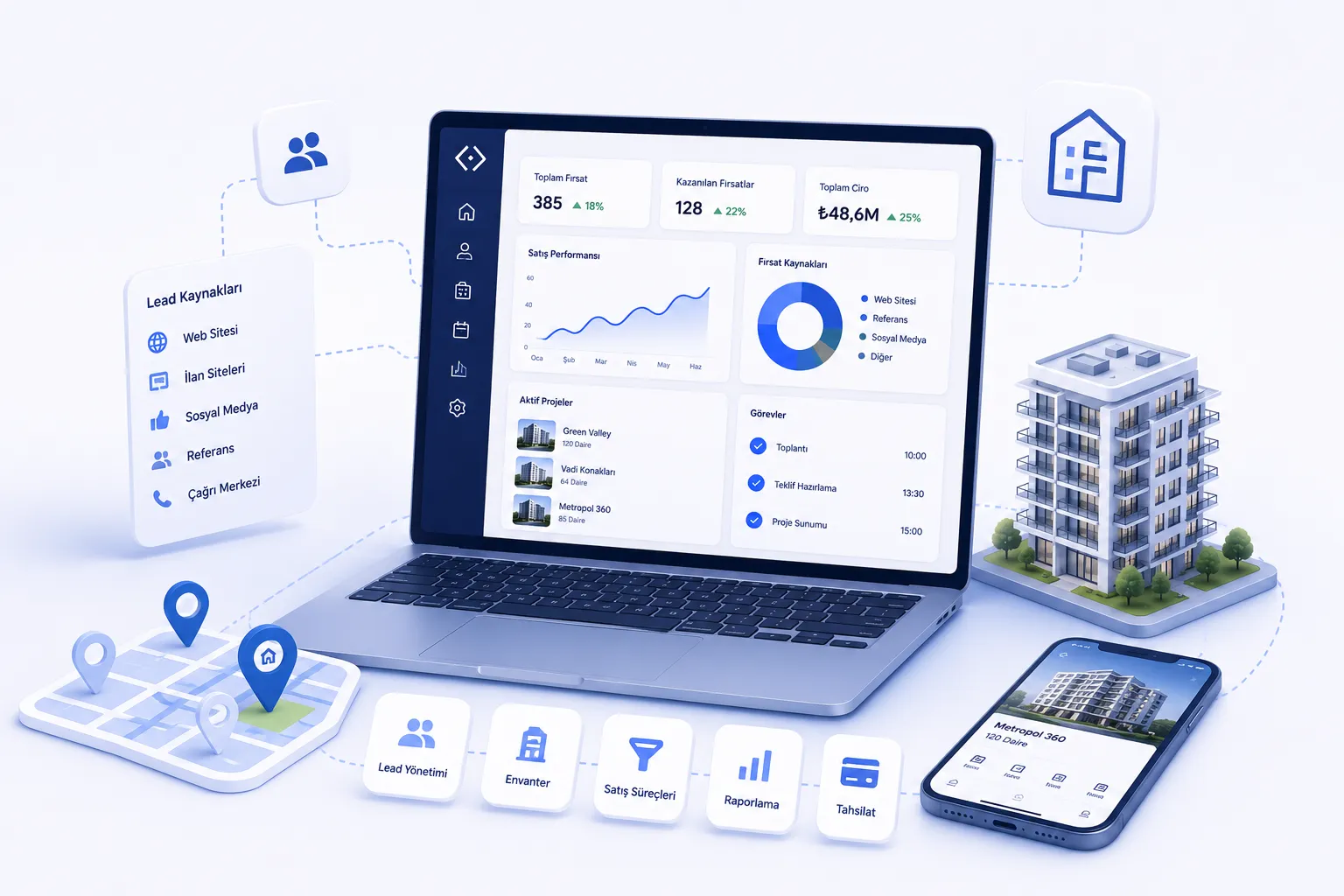

Teams that respond to a buyer within the first 5 minutes close roughly 10 times more sales than those who respond late. According to data compiled by Kixie, 80% of customers expect a reply within the first 10 minutes. So how does a real estate team hit that speed despite dozens of listings and messages a day? The answer comes down to a single concept: real estate sales automation.
In this guide you'll find:
- What sales automation is and why it became standard in 2026
- 8 concrete automation examples used at real estate firms
- A step-by-step roadmap for setting up automation in a real estate office
- How KVKK and İYS compliance relate to automation
What is sales automation?
Sales automation is handing repetitive, manual sales tasks over to software. Steps like lead capture, data entry, follow-up messaging, task assignment and reporting fall within its scope. The goal is to pull the sales team's time away from routine work and redirect it to revenue-generating contacts.
This is no longer a niche choice but a fundamental need. According to industry data compiled by Cirrus Insight, the global sales automation market grew from $7.8 billion in 2019 to $16 billion in 2025. Salesforce research shows sales reps lose 10-20 hours a week to administrative work.
The tasks automation typically takes over are:
- Collecting requests from different channels into one place
- Sending an automatic first response to a new lead
- Assigning tasks and reminders to advisors
- Recording and keeping customer history up to date
- Automatically producing performance reports
Why is real estate sales automation critical?
Real estate is one of the sectors that benefits most from automation. That's because a real estate office simultaneously manages heavy lead traffic, multi-channel communication and a sales cycle that lasts weeks. A buyer writes on WhatsApp today, calls tomorrow, then negotiates by email.
In Turkey this picture is even more pronounced. According to a consumer-habits analysis reported by ÖzgürKod, WhatsApp is the country's most dominant communication channel. Data squeezed between phone contacts, Excel spreadsheets and personal WhatsApp messages leads to forgetting and lost revenue.
The market moves fast too. According to a GPPS analysis based on TÜİK data, 93,333 home sales took place in Turkey in May 2026 alone. At that volume, manually following up on every incoming request is not sustainable. This is where a CRM built specifically for real estate projects steps in and gathers the scattered flow into a single hub.
The impact of automation in numbers
The impact of automation is not an abstract promise but a measurable result. The data below shows what a properly set-up system delivers to a team.
- Return on investment: According to a thisandthat.chat compilation, firms earn back an average of $5.44 for every $1 spent on automation, and 76% see a positive return in the first year.
- Time savings: According to industry statistics, sales reps gain an average of 6 hours a week with automation; with AI-supported tools, savings of up to 2-3 hours a day are possible.
- Response speed: According to RepOrderManagement data, automating lead distribution improves response time by up to 87%.
- Qualified leads: According to the same compilation, lead nurturing automation increases the number of sales-ready leads by 451%.
The common thread across these figures is clear: automation ensures no opportunity slips away. A follow-up forgotten in a manual process becomes an automatic task in the system.
Automation examples at real estate firms
The best way to make the concept concrete is to look at each stage of the sales funnel. The eight examples below show which tasks a real estate firm can hand over with sales automation.
1. Multi-channel lead capture
The system combines requests coming from Facebook, Instagram, WhatsApp, web forms and real estate portals into a single panel. The Meta Lead Ads integration automatically transfers information from ads into the system. That way no prospect gets lost between different channels.
Ready-made integrations are the most practical way to build this flow; WhatsApp Business, NetGSM and the web form API come together in one place.
2. Automatic lead scoring and assignment
Not every lead is the same. AI-supported lead scoring surfaces the hottest prospect by looking at budget, timing and communication signals. The system automatically assigns to the right advisor and creates a priority order.
According to a user experience shared by a Turkish real estate software, when lead distribution was automated, the time to organize a viewing dropped from 6 days to 48 hours. The lead scoring module does this prioritization without advisor intervention.
3. Automatic portfolio-customer matching
In real estate, customer criteria are very specific: location, budget, number of rooms, floor. Automation matches an incoming request with the existing portfolio within seconds. When a suitable new listing appears, the system automatically alerts the relevant customer.
To review the current inventory visually together with the customer, digital 3D model solutions make block, floor and unit selection interactive. Thanks to live stock status, you won't accidentally offer a sold unit again.
4. Automatic follow-up and reminders
Most sales don't close in a single contact. According to HubSpot data, 38% of reps never follow up after the first contact. Automatic follow-up sequences close this gap via WhatsApp, SMS and email.
The system itself signals "it's time to reconnect with this customer." Instead of trying to remember conversations, the advisor focuses directly on selling.
5. Appointment and showing management
Showing a property is the most critical stage of a real estate sale. Automation schedules appointments, sends automatic reminders and follows up on no-show customers. Google Calendar and Zoom integrations also cover remote showings.
The system records which unit a customer viewed and when. The appointment management module runs this tracking automatically through the calendar.
6. Contract, payment and collections automation
The sale continues after the contract too. The system shows all payment movements — down payment, installments, promissory notes and cheques — in a single table. It automatically tracks due dates and delays, and sends collection notifications to the customer on its own.
For residential and construction firms, real estate accounting software gathers payment plans and customer debt status on a single screen. This removes the chaos, especially in project-based installment sales.
7. Reporting and performance dashboards
Who worked how much, which advisor is falling behind on follow-ups, and which ad is paying off become instantly visible. Automatic reporting cuts weekly meeting prep down to minutes. According to RepOrderManagement data, workflow automation reduces reporting time by 27%.
To make data-driven decisions, AI and reporting modules show lead, portfolio and finance performance in real time.
8. After-sales and referral automation
The relationship doesn't end with the title-deed transfer. Automatic satisfaction surveys, periodic check-ins and referral requests keep the after-sales stage alive. A happy customer, with an automatic reminder, turns into a new lead source.
For different team structures, industry-specific solutions adapt this cycle from construction firms to agencies.
How to set up automation in a real estate office
Moving to automation doesn't have to be a giant project. The five steps below provide a practical start for most real estate offices.
- Step — Identify the most time-wasting process. For most offices, that's lead capture and first response. Automate this first.
- Step — Unify all channels in a single inbox. Connect WhatsApp, form and portal requests to the same panel.
- Step — Start with simple rules. Set up triggers like automatic assignment and reminders; leave complex scenarios for later.
- Step — Train the team. As ÖzgürKod emphasizes, hard-to-use systems don't get adopted and turn into idle investment.
- Step — Measure and expand. Track metrics like response time and conversion; add new modules as results come in.
Systems that work with independent modules make this gradual transition easier. You can use the product that fits your needs on its own and add the others as operations grow.
KVKK, İYS and explicit consent
The most neglected side of automation is its legal dimension. In Turkey, sending automated commercial electronic messages is subject to strict rules. Skipping this step creates a direct risk of an administrative fine.
The core obligations are:
- İYS registration: Sending commercial messages to recipients via SMS, email or call requires registration with the Message Management System (İYS) and a consented database.
- Explicit consent: KVKK requires prior, informed explicit consent for processing data for marketing purposes.
- Privacy notice: The purpose for which the data will be processed and to whom it will be transferred must be disclosed in advance.
The Personal Data Protection Board imposed a ₺150,000 administrative fine, per one decision summary, on a firm that sent marketing emails without explicit consent. For this reason, an automation infrastructure must include İYS integration and KVKK compliance from the start.
There is also a new regulation of close concern to the sector. According to the Ministry of Trade's announcement, mandatory application of the Secure Payment System in real estate sales begins on 1 October 2026. An İYS-compliant infrastructure and a transparent KVKK policy are part of preparing for this new era.
Common mistakes
An automation investment won't deliver the expected return when set up wrong. The most common mistakes are:
- Seeing the software only as a "listing tool." The sales process begins after the listing; a system that doesn't manage the customer is incomplete.
- Choosing an overly complex system. Programs that take months to learn don't get adopted by the team.
- Leaving compliance for later. A messaging flow set up without İYS and explicit consent carries the risk of a fine.
- Proceeding without measuring. If response time and conversion aren't tracked, automation's impact stays invisible.
Conclusion
Real estate sales automation is no longer a luxury reserved for large firms; it is a basic condition of competition for real estate offices of every size. The four standout points are:
- Automation takes over routine work, giving the advisor time to focus on selling.
- Eight different processes, from lead capture to collections, can be automated.
- KVKK and İYS compliance are an inseparable and mandatory part of automation.
- The biggest return comes from a gradual transition that starts with the most time-wasting process.
To bring your team's entire process from lead to title deed onto a single platform, request a demo from Evon and see the impact of automation on your office live. For more content, explore the Evon Blog page.
Free Evon demo
See for yourself how Evon can add value to your sales process.
Frequently Asked Questions
What exactly is real estate sales automation?
It is automating repetitive sales tasks such as lead capture, follow-up, matching and reporting with software. It doesn't eliminate the advisor; it saves them time.
When should a small real estate office move to automation?
The best time is when manual follow-up starts to falter and leads begin to slip through. Even single-advisor offices can set up cloud-based systems within minutes.
Is real estate sales automation compliant with KVKK?
Yes, when set up properly. İYS registration, explicit consent and a privacy notice are mandatory for sending automated commercial messages.
Will automation replace real estate advisors?
No. Automation takes on routine work; human stages such as building trust, negotiation and closing stay with the advisor.
Which process should I automate first?
Start with the step that wastes the most time. For most offices, that's lead capture and first-response follow-up.