
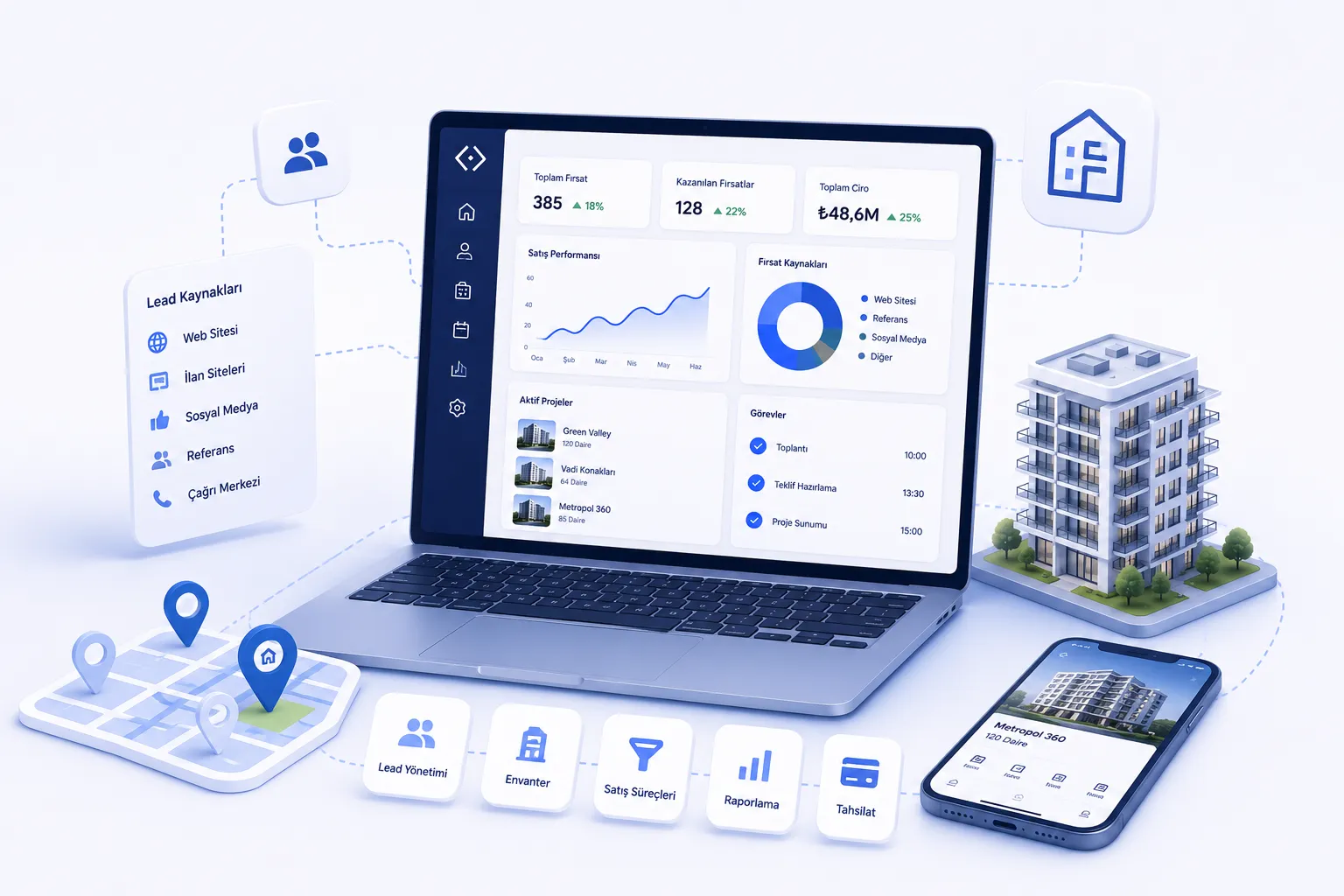
More than 335,000 homes were sold in Turkey in the first quarter of 2025 — a figure that represents a 20% increase over the same period the previous year. Trying to run a sales operation of this volume with Excel spreadsheets and notebooks is an invitation to missed leads, untracked installments and an uncontrolled sprawl of the sales team.
The best real estate CRM software steps in exactly at this point: it lets you manage every step from the prospect's first contact to title-deed handover on a single platform.
In this guide, you'll find the critical features to watch for when choosing real estate CRM software, the industry-specific needs, and a practical framework for making the right decision. Whether you manage a 10-unit boutique project or run the sales of a large-scale project of hundreds of homes, this guide will give you the information you need to find the most suitable solution.
Why is a CRM in real estate no longer a luxury but a necessity?
The real estate sector has undergone a radical change in the last few years. As the number of prospects arriving from digital ads has multiplied, buyers' decision-making process has also lengthened. In a housing project, the average sales cycle lasts 3-6 months, and throughout this period, communication with dozens of prospects must be managed simultaneously.
Firms working with traditional methods experience serious losses in this cycle. Customer information is scattered across the phones of different sales reps, it becomes unclear when to get back to which customer, and the window of opportunity closes.
In Turkey specifically, KVKK regulations, the heavy customer traffic running over WhatsApp and the multi-channel lead flow make a digital management system essential. A prospect comes from an Instagram ad, gets in touch on WhatsApp, visits the sales office and negotiates by phone — if all these touchpoints aren't unified in one place, the customer experience stays fragmented and inconsistent.
A real estate CRM has now become an infrastructure needed not just by large holdings, but even by boutique construction firms working with a 3-5 person sales team. According to KPMG Turkey's sector-outlook report, the construction sector recorded real growth of 7.8% in 2023, and this growth trend is expected to continue. In a growing market, the competitive advantage is now in favor of those who use technology.
What is a real estate CRM and how does it differ from a general CRM?
A CRM (Customer Relationship Management) is software used to gather customer data on a central platform, track sales processes and organize communication. But there are critical differences between a general-purpose CRM and a real-estate-specific CRM.
General CRM vs. real estate CRM
General CRM software (like Salesforce, HubSpot, Zoho) is strong at keeping customer records and managing the sales funnel. But these systems require extensive customization to meet real estate's unique needs. Adding a housing project's block-floor-unit hierarchy, payment due dates or the title-deed process to a general CRM means both extra development cost and lost time.
A real estate CRM, on the other hand, is designed to fit the sector's workflow: processes like unit inventory management, floor-plan-based stock tracking, payment-plan creation, and installment and cheque/promissory-note tracking are in the software's DNA. That way you can start managing your sector processes from day one, without needing long customization cycles.
The distinction between a real estate agency CRM and a developer CRM
There is an important distinction here that is often overlooked. A real estate agency CRM is focused on portfolio management and customer-portfolio matching. Listing existing properties and matching them with buyers is the core workflow.
A developer and construction firm CRM, on the other hand, manages a completely different process: project-based sales, unit reservation, presentation via a digital 3D model, payment-plan creation and collections tracking. Here the customer journey is defined as "from lead to title deed," and the CRM covers every step of this journey.
If you are a construction firm or a developer, CRMs aimed at real estate agencies will not meet your needs. You need to look for a solution specific to your sector.
The 8 features the best real estate CRM must have
There are dozens of real estate CRM software options on the market. To make the right choice, check the following 8 core features.
1. Lead capture and automatic distribution
Prospects arriving from Google Ads, Facebook, Instagram and website forms dropping automatically into the CRM and being distributed to sales reps is the top priority. Research shows the conversion probability of leads answered within the first 5 minutes increases 21-fold.
A good real estate CRM tags the lead source, detects duplicate records and assigns based on prioritization rules.
2. WhatsApp and call integration
In Turkey, a large part of real estate communication runs over WhatsApp. The CRM working integrated with the WhatsApp Business API ensures messages drop into the customer card automatically and all communication history is kept in one place.
Similarly, with virtual-PBX integration, incoming and outgoing calls are recorded. This feature makes it easier both to measure sales performance and to monitor customer complaints.
3. Inventory and stock management
In housing projects, the status of each unit (for sale, under option, reserved, sold) must be visible in real time. A good CRM offers a floor plan or block-based visual inventory. In front of the customer, the sales rep can see within seconds which units are available.
Consider a typical scenario: the customer is looking for a 3+1 unit, prefers a south façade and wants the 5th floor or above. With filtering in the CRM, suitable units are listed instantly. Doing this filtering in Excel both takes time and carries a risk of error.
Without this feature, the risk of a double sale arises — promising the same unit to two different customers leads to both reputational and legal problems. Inventory management is vital especially when multiple sales reps work on the same project.
4. Digital 3D model and interactive presentation
Classic physical models are both costly and hard-to-transport tools. Modern real estate CRMs let you walk the customer through the project on screen with 3D digital-model integration.
The ability to prepare customer-specific, branded presentation content also increases sales professionalism. The units the customer is interested in, the floor plan, price and payment options are compiled in a single presentation file and shared via WhatsApp or email.
5. Payment plan and installment tracking
At construction firms, the sale doesn't end with signing the contract. Complex payment structures such as down payment, installments, promissory notes, cheques and rate differences must be tracked for months, even years.
The CRM's accounting module should create each customer's payment plan, send a reminder when a due date arrives and report the collection status in real time. Being able to see all payments in a single table is critical for cash-flow planning.
6. KVKK-compliant data management
Personal Data Protection Law no. 6698 directly concerns every firm that collects and processes customer data. Real estate firms collect sensitive data such as name, phone, email, income information and home preferences.
The CRM software must offer KVKK-compliant consent management and data-retention and deletion policies. Otherwise, you may face administrative fines and reputational loss.
7. Reporting and analytics
The information a sales manager needs most is: Which lead source delivers the most conversions? Which sales rep shows the highest performance? How close are we to the monthly collections target?
A good real estate CRM presents the answers to these questions on a single dashboard. Real-time reporting lets you make data-driven decisions and speeds up the shift from intuitive management to systematic management.
8. Mobile access and field support
Real estate sales happen in the field. Sales reps must be able to access the CRM outside the office, on the construction site or during a customer visit. Solutions that are mobile-friendly or have a native mobile app directly increase field-team efficiency.
Actions like instantly updating customer information, adding photos and creating appointments should be doable on mobile.
5 questions to ask when choosing a real estate CRM
To find the right CRM, be sure to ask these questions when evaluating the alternatives on the market:
- Is it industry-specific or a general CRM? General CRMs offer flexibility but require you to build from scratch the inventory management, payment plans and unit-based tracking real estate needs. Industry-specific solutions offer these processes ready-made.
- Which channels does it integrate with? WhatsApp, Google Ads, Facebook Lead Ads, website forms and virtual-PBX integrations are must-have features. Lack of integration means manual data entry — which creates both lost time and a risk of error.
- How is it priced? Per user, per project, or a flat fee? Are there hidden costs (setup fee, additional module fee, data-storage limit)? Can it scale as you grow?
- Are data security and KVKK compliance ensured? Always ask where the data is hosted, the encryption methods and the data-processing procedures under KVKK. Solutions with a data center in Turkey or that use KVKK-compliant cloud infrastructure should be preferred.
- Is support in your language and how fast? Global CRMs offer powerful features but local-language support is often limited. When you hit an urgent problem, waiting in an English support queue directly affects your sales process. Local solutions have an advantage here.
The hidden costs a construction firm without a CRM pays
Seeing a CRM investment as a "cost" is a common mistake. The real cost is hidden in not using a CRM.
Escaped leads
If your digital ad budget brings in 500 prospects a month and you can't get back to 30% of them in time, you're losing 150 potential customers every month. According to global data, the conversion rate of internet leads is around 2-3%. 150 escaped leads can mean the loss of 3-5 sales.
What's more, ad budget has already been spent on these leads. Every untracked lead is wasted ad spend. A CRM system directly increases the return on ad investment by ensuring these leads are automatically recorded and assigned.
Untracked installments
In payment plans managed in Excel, overdue installments are easily missed. Imagine that each of 200 units in a housing project has 12 installments — that's 2,400 separate payment items. A single mistake disrupts both cash flow and the customer relationship.
Dependence on the sales rep
Without a CRM, customer information stays in the sales rep's personal memory and phone. When a rep leaves, hundreds of customer records and relationship history go with them. For the firm, this means starting from scratch again and again.
The domino effect of Excel errors
A formula error in one cell can break the entire payment table. When a wrongly calculated balance is conveyed to the customer, trust is shaken, a correction process begins and the professional image is damaged. While home sales in Turkey are usually TL-based, exchange-rate differences must also be tracked in transactions with foreign investors. Managing this complexity error-free in Excel is nearly impossible.
Beyond that, when Excel files are shared, a version-control problem begins. It becomes unclear which file is current, different people work on different versions, and data integrity breaks down.
The sum of these hidden costs is far above the annual license fee of a CRM software. The investment in a CRM is actually an investment made to recover lost revenue and minimize operational risk.
Conclusion: The right CRM turns sales into a system
Success in the real estate sector is now determined not just by a good location or an attractive price, but by how professionally and systematically the sales process is managed. In an increasingly competitive environment, those who make the difference are the firms that reach the customer with the fastest and most accurate information.
When choosing the right real estate CRM software, don't forget these four principles: it should be industry-specific, unify multi-channel communication in one place, cover payment and accounting processes, and work in a KVKK-compliant way. A CRM that meets these four criteria doesn't just make the sales team's job easier — it also gives the manager the power to decide with real-time data.
The earlier the decision to move to a CRM is made, the more valuable the data that accumulates. Six months later, looking back, you'll be able to see clearly which lead source delivered the best conversion, which sales rep worked most efficiently and the true picture of your cash flow.
Evon, as an ecosystem that offers all of real estate's tools from sales to accounting under one roof, runs its CRM, digital 3D model, presentation and accounting modules in an integrated way. With a structure covering all processes from lead management to installment tracking, from WhatsApp integration to 3D project presentation, it is designed specifically for the needs of developers and construction firms.
Free Evon demo
See for yourself how Evon can add value to your sales process.
Frequently asked questions
How long does real estate CRM software take to set up?
Cloud-based solutions usually become active within 1-2 weeks. Including data transfer and team training, the total time averages 2-4 weeks. For systems requiring on-premise installation, this period can extend to 1-3 months.
What is the most important criterion when choosing real estate CRM software?
Being industry-specific is the most critical criterion. General CRMs don't offer the inventory management, payment-plan tracking and unit-based stock control real estate requires out of the box. If you are a developer or construction firm, you should look for a solution covering the entire "lead to title deed" process.
Can existing customer data in Excel be imported into the CRM?
Yes. The vast majority of professional real estate CRM software supports bulk data import in CSV and Excel format. Cleaning duplicate records and standardizing the data before import is recommended.
How does WhatsApp integration work in a real estate CRM?
Messages arriving via the WhatsApp Business API drop directly into the customer card in the CRM. The sales rep replies from the CRM panel and all communication history is recorded chronologically. That way what was discussed with which customer is never lost.
Should you prefer a cloud-based CRM or an on-premise installation?
Cloud-based solutions stand out for the real estate sector. Field teams get mobile access, updates and backups are automatic, and the initial cost is low. On-premise installation can be considered for large-scale firms with high security requirements.